
Mobile service is easy to think about as a convenience play. A customer needs an oil change, battery replacement, recall, or other routine service, and instead of asking them to drive to the dealership and wait, you send the service to them.
That is certainly part of the appeal. But once mobile service starts growing, convenience is only the beginning.
At Bozard Ford Lincoln, Remote Services Director Jeremy Stephens has watched the operation grow from seven vans and a relatively blank slate to 47 mobile service vehicles and more than 2,300 repair orders in a recent month.
At that scale, mobile service stops looking like an add-on. It becomes its own operating model, complete with new processes, technology needs, customer relationships, and opportunities that stretch well beyond the service lane.
What Gets You to 700 ROs Won’t Get You to 2,000
One of the clearest lessons from Bozard’s growth is that there is no single mobile service playbook you can build once and leave alone. As volume increased, Jeremy’s team had to rethink everything from parts logistics to scheduling and routing.
Processes that worked when the operation was smaller became less effective as more vans, technicians, customers, and appointments entered the picture. The team regularly goes back to the basics, sometimes every few months, to ask what has become unnecessarily complicated and what needs to change.
That mindset matters because mobile service can create a strange problem for successful dealerships: the better the program performs, the more pressure it puts on the systems supporting it.
Adding another van is relatively straightforward. Making sure that van has the right work, the right parts, an efficient route, and enough productive time in the day is much harder.
For dealerships looking to grow mobile service, the question is not simply how many vans they can put on the road. It is whether their processes can keep pace once demand increases.
Your Next Service Bay Might Be a Driveway
Bozard’s mobile operation originally grew in part because the traditional shop was struggling with capacity. At one point, customers could be looking at a roughly six-week wait. Mobile service provided another way to get work completed without adding another traditional service bay.
That does not mean every mobile appointment looks the same.
Retail work often requires more driving between individual homes and workplaces, which makes routing especially important. Fleet work can be very different. A technician may arrive at one location and service five, 10, or even 20 vehicles without getting back in the van.
Bozard learned the importance of that efficiency firsthand. Early on, scheduling relied heavily on spreadsheets and manual coordination. Technicians could spend three or four hours of the day driving, sometimes crossing paths with other vans or ending up in the same part of town.
Routing technology helped change that. Better clustering, more automated scheduling, and stronger integrations with dealership systems have made it possible to handle much greater volume without simply piling complexity onto the operation.
The lesson is not that technology solves mobile service. It is that once mobile reaches a certain size, good routing and scheduling become just as fundamental as technician productivity inside the shop.
Convenience Gets the Appointment, Relationships Bring Customers Back
The operational benefits of mobile service are important, but one of its most interesting effects happens at the customer level: It changes who the customer interacts with.
Inside a traditional dealership experience, the service advisor is usually the bridge between the customer and the technician. Mobile service can remove some of that distance.
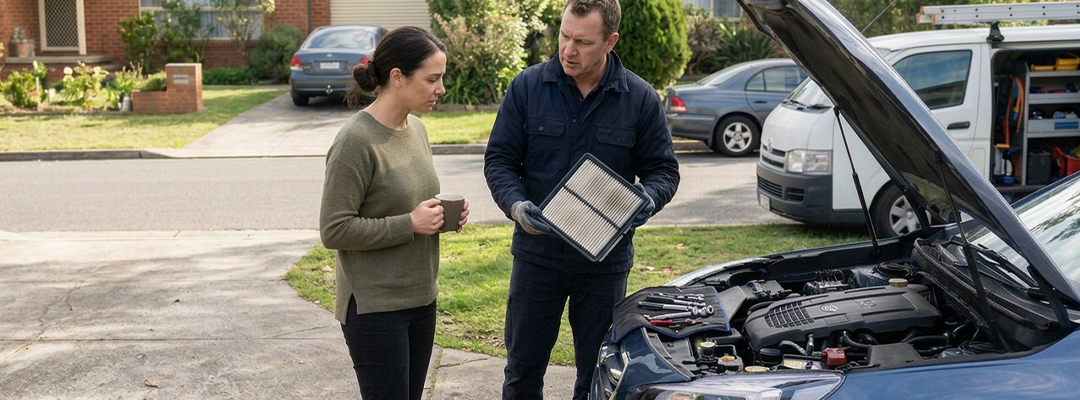
The technician is standing in the customer’s driveway. They can show the customer a dirty cabin air filter. They can answer a question about a vehicle feature. They can explain what they found while working on the vehicle without the conversation passing through several people first.
Jeremy has seen customers begin requesting specific technicians by name.
They do not just want another mobile appointment. They want whichever technician they have come to trust, to come back. Those technicians are also showing up by name in reviews.
In some ways, mobile service recreates something dealerships have been trying to preserve for years: the feeling that a customer has “my mechanic.”
That relationship is difficult to quantify, but it has obvious implications for retention. Convenience may persuade someone to try mobile service once. Trust in the person servicing the vehicle gives them another reason to keep coming back.
The Demand Is There. The Awareness Still Isn’t.
For all the growth in mobile service, many customers still do not know whether it is available to them. DriveSure’s 2026 Dealership Service Retention Report found that 48% of dealership service customers say they would be likely to use mobile service. At the same time, 60% said they did not know whether their dealership offered it.
Jeremy sees that awareness gap even with 47 vans operating throughout the market. Customers still encounter Bozard’s mobile operation and say they did not know the dealership offered the service. Some call multiple dealerships before finding one that can come to them. That makes mobile service a marketing and customer experience challenge as much as an operational one.
It also means dealerships need to look closely at how easy they make the service to schedule once a customer does discover it.
Bozard simplified its online scheduling process to roughly three to five clicks after seeing customers abandon a more complicated experience. Jeremy says online appointments doubled after that process became easier.
Language matters too. Dealership teams may understand opcodes, package names, and internal service terminology. Customers usually do not. If someone has to decode dealership language just to figure out what to book, the convenience promise starts breaking down before the appointment is ever scheduled.
A successful mobile program has to be easy to find, easy to understand, and easy to book.
Mobile Service Can Reach Beyond Fixed Ops
Mobile service can also create opportunities that are harder to see if it is treated strictly as a service department initiative.
Fleet is one example.
Jeremy moved his office closer to Bozard’s fleet sales team and has joined salespeople on customer visits. The connection makes sense. Mobile service can help a dealership get in the door with a business, support the vehicles after the sale, and stay visible throughout the ownership cycle.
That ongoing service relationship can work in the other direction too. A business that repeatedly relies on a dealership to maintain its vehicles has another reason to consider that dealership when it is time to replace or expand the fleet.
Mobile also puts the dealership in front of people who may not currently be its customers.
A van pulls into a neighborhood. A neighbor sees it and asks whether the dealership can work on another make or whether they had to buy their vehicle there. In Bozard’s case, the answer may be no.
The service appointment becomes a small piece of local advertising and, potentially, a first interaction with someone who has never done business with the dealership.
The harder question is how to measure what happens next.
Jeremy said the fleet side is easier to track through CRM activity. Retail attribution is less mature. Bozard has considered asking customers whether mobile service influenced their decision to purchase from the dealership.
That may become an increasingly important metric as mobile service matures.
Because if the program can create service capacity, introduce new customers to the dealership, strengthen relationships with existing ones, and support the next vehicle sale, its value is much larger than the number of repair orders it produces.
Final Takeaway: Mobile Service Is Growing Up
The conversation around mobile service is changing. The question is becoming less about whether customers want the convenience. Many clearly do.
The bigger challenge is what happens after a dealership decides to offer it. Can the operation scale without becoming inefficient? Can customers easily find and schedule it? Can technicians create the kind of direct relationships that keep people coming back? Can service and sales work together to turn those relationships into longer-term dealership loyalty?
Bozard’s growth shows what mobile service can become when it is treated as more than a van and a technician. At scale, it is not simply another way to complete an oil change. It is another way to run the service business.
Want to hear the full conversation with Jeremy Stephens? Listen to the full episode here.
Need help making retention feel automatic?
DriveSure helps dealerships turn oil changes into lasting relationships—with renewable benefits, service-lane prepaid maintenance, and customer-first communication tools that drive results. Book a consultation today