

Appointment availability is one of those issues that’s easy to underestimate because it rarely creates a scene.
In DriveSure’s 2026 retention study, 26% of customers said limited appointment availability would cause them to service somewhere else. But most of those customers probably aren’t calling to explain why.
They just need an oil change, tire rotation, or repair. If your next opening feels too far out, they’ll look for another option that fits their schedule.
That’s the real risk. By the time appointment availability shows up in your retention numbers, the customer may already have tried another shop.
A Full Calendar Can Still Cost You Customers
A packed schedule usually feels like a win. The bays are full, advisors are busy, and demand is there. But from the customer’s side, “we’re booked out” can sound a lot like “try somewhere else.”
This is especially risky online. A customer goes to book an appointment, sees nothing available for a week or two, and then what? If there’s no message, waitlist, callback option, or easy way to talk to someone, that customer is left to solve the problem on their own.
That usually means searching for another shop.
That doesn’t mean every dealership needs to magically create more capacity overnight. But it does mean the scheduling experience can’t hit a dead end.
If the calendar is full, tell the customer what to do next. Offer a callback. Give them a number to call. Let them join a waitlist. Explain which services might be available sooner. Even a simple message like, “Need something sooner? Contact our team and we’ll do our best to help,” is better than leaving them stuck.
Because to the dealership, it may just look like a busy week.
To the customer, it may feel like the first sign that servicing somewhere else would be easier.
Not Every Customer Wants to Book the Same Way
It’s easy to assume online scheduling is the answer. And for a lot of customers, it is. But the data shows a pretty even split overall: 43% of customers prefer to book online, while 44% still prefer to call. So if your scheduling strategy is built around pushing everyone to one channel, you’re probably creating friction for a big chunk of your customer base.
The age breakdown makes it even clearer.
For customers under 54, online scheduling is the dominant preference. More than 60% prefer it. But for customers 55 and older, only 34% prefer booking online, while half still prefer to call. That older group is also much more likely to want to book their next appointment before leaving the dealership.
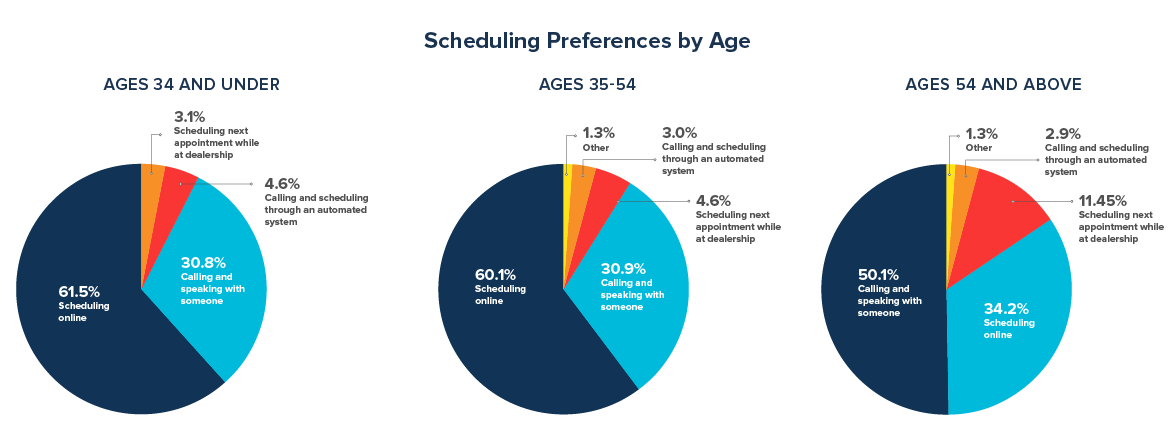
Some people want to book from their phone at 9 pm. Some want to talk to a real person. Some would rather set the next appointment while they’re already standing at the counter.
If your dealership makes one of those paths easy and the others painful, you’re giving certain customers a reason to try someone else.
Turn Checkout Into a Retention Moment
The easiest time to get a customer back on your schedule is while they’re still in the building.
Nearly 10% of customers said they prefer to book their next appointment before leaving the dealership. That may not sound like a huge number at first, but it’s still a meaningful group of people actively telling you, “Make this easier for me now.”
A future appointment gives the customer one less thing to figure out later. They don’t have to remember when they’re due, search for a time, or compete for a spot when the schedule is already tight. You’ve already helped them take the next step.
It doesn’t need to be complicated or pushy. It can be as simple as:
“Looks like you’ll be due again around September. Want me to pencil something in now so you’ve got a spot?”
That one small step reduces friction, gives the customer a clear path back, and keeps the next visit connected to your dealership instead of leaving it up for grabs.
Communication Starts Before the Visit
Once the appointment is booked, the scheduling experience isn’t over.
Customers still want to know the basics:
- Did the appointment go through?
- What time should they arrive?
- Where should they pull in?
- Will someone remind them?
- If something changes, how will they hear about it?
That’s where a lot of dealerships can tighten things up.
The report found that 72% of customers prefer text updates while their vehicle is being serviced, but that preference doesn’t have to start after check-in. A simple confirmation text, reminder text, or day-of message can make the whole experience feel easier before the customer ever reaches the service drive. Every clear touchpoint makes the next visit feel a little more locked in.
Final Takeaway: Treat Scheduling Like a Retention Strategy
Appointment availability can look like a capacity problem. And sometimes it is, but it’s also a loyalty problem.
A customer who can’t get in when they need service isn’t thinking about your staffing levels, technician count, or shop load. They’re thinking about how quickly they can get the problem handled.
That’s why scheduling needs to be part of the retention conversation.
Make the online path clear. Make the phone path easy. Give customers a next step when the calendar is full. Ask about the next appointment before they leave. And use simple communication to keep the visit from feeling like something they have to manage on their own.
The goal should be to make sure the next time that customer needs service, coming back to you still feels like the easiest choice. Listen to the full episode here.
Need help making retention feel automatic?
DriveSure helps dealerships turn oil changes into lasting relationships—with renewable benefits, service-lane prepaid maintenance, and customer-first communication tools that drive results. Book a consultation today.